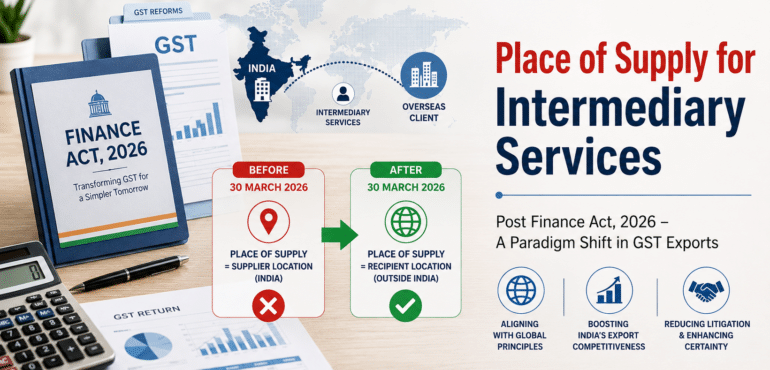

Place of Supply for Intermediary Services – Post Finance Act, 2026: A Paradigm Shift
Introduction: End of a Long-Standing Controversy
If one were to identify a single provision in the GST law that generated disproportionate litigation relative to its length, Section 13(8)(b) of the IGST Act, 2017 would be a strong candidate. A two-line sub-clause, yet responsible for years of courtroom battles, advance rulings, departmental disputes, and genuine commercial hardship for India’s services export ecosystem.
The issue was deceptively simple: Indian entities acting as intermediaries for overseas clients were denied the benefit of export classification — not because of any flaw in their commercial arrangement, but because the law statutorily deemed the place of supply to be the location of the supplier in India. This single deeming fiction overrode the foundational destination-based principle of GST and imposed domestic tax liability on what were, in every commercial sense, cross-border service transactions.
The Finance Act, 2026 — which received Presidential assent on 30th March 2026 — has addressed this through the omission of Section 13(8)(b). This is a defining moment for India’s indirect tax jurisprudence and sits squarely within the broader agenda of GST 2.0: rationalizing the framework, reducing litigation, and enhancing India’s competitiveness as an export destination for services.
For Indian exporters — particularly in IT/ITES, Global Capability Centres (GCCs), BPO, marketing support, procurement facilitation, and cross-border consulting — this amendment is a significant relief long overdue.
Defining Intermediary Services — The Statutory Framework
The Statutory Definition
Section 2(13) of the IGST Act defines an intermediary as:
“a broker, an agent or any other person, by whatever name called, who arranges or facilitates the supply of goods or services or both, or securities, between two or more persons, but does not include a person who supplies such goods or services or both or securities on his own account.”
The definition is not inclusive — it uses “means” and not “includes.” Its scope is therefore precise and bounded.
The Concept Borrowed from Service Tax
The concept of intermediary is not a GST invention. It was borrowed from the Service Tax regime, specifically from Rule 2(f) of the Place of Provision of Services Rules, 2012. The definition under GST is substantially identical to the Service Tax definition, with one addition — the inclusion of “securities” within the scope of arrangements that an intermediary may facilitate. The legal character and interpretational principles that evolved under Service Tax therefore remain relevant reference points.
CBIC Circular No. 159/15/2021-GST — Three Primary Requirements
Despite the statutory definition, classification disputes were rampant. CBIC issued Circular No. 159/15/2021-GST dated 20th September 2021 to bring uniformity. The Circular crystallized three foundational requirements for a service to qualify as an intermediary service:
a) Minimum of Three Parties
An intermediary arrangement must, by definition, involve at least three persons — two principals transacting in the main supply, and the intermediary arranging or facilitating that transaction. A bilateral arrangement between only two parties cannot, in law, constitute intermediary services.
b) Two Distinct Supplies
Every intermediary arrangement involves two legally separate supplies: the main supply (between the two principals — which could be goods, services, or securities) and the ancillary supply (the intermediary’s service of facilitating the main supply). The ancillary supply must be clearly identifiable and distinct from the main supply.
c) Facilitation Role — Not Principal-to-Principal Supply
The intermediary’s role is supportive and subsidiary. The intermediary facilitates another’s supply — it does not itself provide the main supply on its own account. Where a person provides the main supply (wholly or partly) on a principal-to-principal basis, they fall outside the scope of the intermediary definition. Sub-contracting, BPO services, and software development outsourcing are excluded on this basis.
Practical Implication:
The classification question is not about the industry or the label — it is about the role in the transaction. If you are a BPO providing customer care services directly under a contract with an overseas client, you are providing the main supply on your own account and are not an intermediary. If you are a commission agent helping your foreign principal sell goods in India, you are an intermediary.
The Statutory Framework and Position Prior to Amendment
The Architecture of Section 13
Section 13 of the IGST Act governs the place of supply of services where either the supplier or the recipient is located outside India. The provision is crucial because export classification under Section 2(6) requires, inter alia, that the place of supply be outside India.
The default rule under Section 13(2) locates the place of supply at the location of the recipient — consistent with the destination-based taxation principle that forms the cornerstone of modern GST/VAT frameworks globally.
The Exception: Section 13(8)(b)
Section 13(8)(b) carved out a specific, overriding exception for intermediary services:
“The place of supply of the following services shall be the location of the supplier of services… (b) intermediary services”
This meant that regardless of where the recipient was located — whether in the USA, UK, Singapore, or anywhere else — the place of supply of intermediary services was always India, i.e., the supplier’s location.
Consequences of the Pre-Amendment Position
The commercial and legal consequences were severe and cascading:
| Consequence | Impact |
|---|---|
| Place of supply = India | Failed the “outside India” condition for export of services under Section 2(6) |
| No export classification | Zero-rated benefit under Section 16 of IGST Act unavailable |
| GST payable on full value | Even when entire consideration was received in foreign exchange |
| ITC accumulation | No refund of accumulated input tax credit |
| Cost competitiveness lost | Embedded GST became an unrecoverable cost for the exporter |
Indian entities — particularly in IT, GCC operations, BPO, marketing support, and global procurement facilitation — bore the brunt of this provision. A tax meant to apply to domestic consumption was effectively being levied on services consumed entirely outside India.
Litigation Landscape
The provision witnessed widespread challenge across forums. Despite CBIC’s clarification vide Circular No. 159/15/2021-GST, disputes continued at Advance Ruling Authorities, GST Appellate Authorities, and High Courts. The core tension between the statutory deeming fiction in Section 13(8)(b) and the destination-based philosophy of GST never found satisfactory resolution within the existing framework — making a legislative correction the only meaningful remedy.
The Amendment: Finance Act, 2026 — Omission of Section 13(8)(b)
The Legislative Change
Pursuant to the recommendation of the GST Council at its 56th Meeting held on 3rd September 2025, and in response to sustained industry representations, the Finance Act, 2026 has omitted Section 13(8)(b) from the IGST Act. This is effected through Section 157 of the Finance Act, 2026.
The GST Council’s recognition of this issue at its 56th Meeting was itself a landmark — acknowledging that the existing position caused genuine hardship and distorted the competitiveness of Indian service exporters.
Effect of the Omission
With the omission of Section 13(8)(b), the carve-out that placed intermediary services at the supplier’s location no longer exists. Intermediary services now fall squarely under the default rule of Section 13(2) — i.e., the place of supply is the location of the recipient of services.
This is a structural correction. Intermediary services have been brought back within GST’s foundational destination-based framework, consistent with how the overwhelming majority of services are treated under the IGST Act.
Effective Date — A Critical Determination
The effective date of this amendment has important implications for transitional positions and pending matters.
The Finance Act, 2026 received Presidential assent on 30th March 2026.
Accordingly, the omission of Section 13(8)(b) is effective from 30th March 2026.
This is not a prospective budget-date amendment. The change operates from the date of Presidential assent, not from 1st April 2026, a distinction that carries practical significance for transactions straddling the date.
Impact Analysis — Before and After 30th March 2026
Comparative Position at a Glance
| Particulars | Position before 30th March 2026 | Position from 30th March 2026 |
| Place of supply — Intermediary Services | Location of supplier in India [Section 13(8)(b)] | Location of the recipient [Section 13(2) — default rule] |
| Intermediary services to a foreign party | Not export → GST payable → No ITC refund | Export of services* → Zero-rated → ITC refund available |
| Intermediary services received from a foreign party | Not import of services → No RCM | Import of services → IGST payable under RCM |
Subject to fulfillment of all conditions of export of services under Section 2(6) of the IGST Act.
Outbound Services — Export of Service | The Primary Beneficiary
This is where the amendment delivers its most consequential impact.
For Indian entities providing intermediary services to overseas recipients, where the five conditions of Section 2(6) are satisfied — supplier in India, recipient outside India, place of supply outside India, consideration in convertible foreign exchange, and supplier and recipient not being establishments of the same entity — the transaction now qualifies as an export of services.
The commercial implications are material:
- Zero-Rating under LUT: Services can be supplied without payment of IGST under a valid Letter of Undertaking, eliminating the working capital burden entirely.
- Refund of Accumulated ITC: Unutilized input tax credit can be claimed as refund under Section 54(3) of the CGST Act — addressing years of ITC lock-up for affected businesses.
- Pricing Competitiveness: The elimination of embedded, non-recoverable GST cost enables Indian intermediary service providers to price competitively in the global market.
- GCC and BPO Ecosystem: India’s positioning as the preferred destination for Global Capability Centres, shared service operations, and outsourced facilitation business is materially strengthened.
Inbound Services — Import of Service and RCM | The New Obligation
The amendment is a double-edged development. The same change that benefits Indian exporters simultaneously creates a new tax obligation for Indian businesses receiving intermediary services from foreign service providers.
Prior to 30th March 2026, with the place of supply for intermediary services at the supplier’s location (i.e., outside India when the supplier is foreign), the transaction did not constitute an “import of services” within Section 2(11) of the IGST Act, and accordingly no RCM liability arose.
Post-omission, with the place of supply now at the recipient’s location (India, when the recipient is an Indian business), the transaction squarely qualifies as import of services under Section 2(11). This triggers IGST liability under the Reverse Charge Mechanism (RCM) under Section 5(3)/(4) of the IGST Act.
Sectors that are particularly exposed include:
- Hotels and hospitality receiving services from overseas travel agents or booking intermediaries
- Airlines procuring services from foreign cargo or ticketing agents
- Financial services entities using overseas securities brokers or fund facilitation agents
- Petroleum and other sectors with restricted ITC eligibility — for whom RCM becomes an absolute cost
Action Points for Businesses
The amendment demands immediate and deliberate action. A reactive approach carries the risk of missed opportunities on the export side and undetected compliance exposure on the import side.
For Indian Intermediary Service Exporters:
- Execute or renew Letter of Undertaking (LUT) to supply zero-rated services without payment of IGST
- Conduct a review of accumulated ITC balances and initiate refund claims under Section 54(3) of the CGST Act
- Revisit the classification of all outbound service arrangements — separate principal-to-principal contracts from genuine intermediary arrangements
- Update invoicing templates, contract terms, and internal documentation to reflect the corrected export position
- Evaluate contracts spanning pre- and post-30th March 2026 for appropriate transitional tax positions
For Indian Businesses Receiving Foreign Intermediary Services:
- Identify all inbound arrangements where a foreign entity facilitates supplies to or for the Indian business
- Assess RCM liability from 30th March 2026 and plan for self-assessment and payment
- Evaluate ITC eligibility on the RCM discharge — particularly critical where the business has restricted ITC
- Review commercial contracts with foreign intermediaries for pricing adjustments to factor in the new tax cost
Conclusion
The omission of Section 13(8)(b) of the IGST Act through the Finance Act, 2026 is more than an amendment — it is a correction of a structural anomaly that should not have persisted for as long as it did.
For nearly nine years, a statutory deeming fiction placed India’s intermediary service exporters at a competitive disadvantage, denied them legitimate export benefits, and generated disputes that consumed taxpayers’ and the adjudicating machinery’s time and resources in equal measure. The 56th GST Council’s recommendation and Parliament’s legislative action represent a belated but decisive course correction.
The amendment reflects the direction that GST 2.0 has been charting — rationalizing provisions that create friction without corresponding policy justification, easing the compliance burden for genuine exporters, and ensuring that the tax framework is a facilitative rather than an impediment to India’s role in global trade.
Intermediary services are now where they always belonged — within the destination-based framework. For Indian exporters, the door to zero-rating and ITC refunds is now open. The task is to walk through it correctly — with proper documentation, timely LUT renewals, and precise classification.
This blog is intended for general information and professional discussion. Readers are advised to seek specific professional advice based on the facts of their transactions before taking positions.